
Orissa , is a state located on the east coast of India.
Orissa is a littoral state of India with a long coastline and a storehouse of mineral wealth. Because of its mineral wealth and strategic location it attracts foreign investment in steel, aluminum, power, refineries, and infrastructure. Many foreign steel companies ,like Arcelor Mittal and POSCO have invested money to make steel plants in the state. Orissa is also emerging as a player in the outsourcing IT (Information Technology) and IT services industry. The total planned investment in the state is projected to be 90 billion U.S. dollars. However, there are environmental concerns and land acquisitions for some of these projects have been opposed by the local people.
The relatively unindented coastline (c.200 mi/320 km long) lacks good ports, except for the deepwater facility at Paradip. The narrow, level coastal strip, including the Mahanadi River delta, is exceedingly fertile. Orissa is home to the Hirakud Dam, one of the longest dams in the world. Rainfall is heavy and regular, and two crops of rice (by far the most important cereal) are grown annually.
The coastal alluvial plain is inhabited by the non-tribal speakers of the Oriya language. The interior, inhabited largely by the indigenous people known as Adivasis is hilly and mountainous. Orissa is subject to intense cyclones; in October 1999, Tropical Cyclone 05B caused severe damage and some 10,000 deaths.
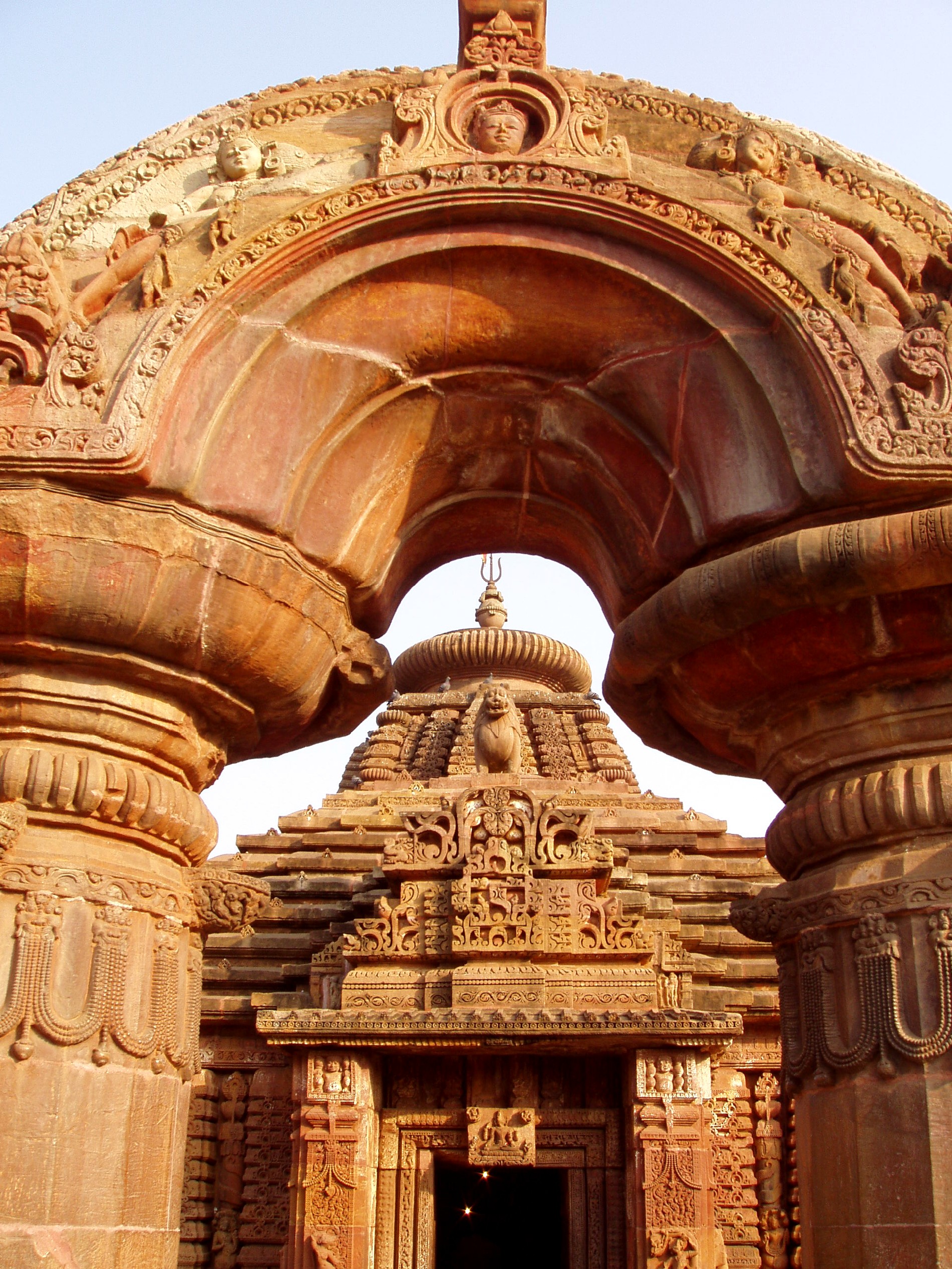
Orissa has several popular tourist destinations. Puri, with the Jagannatha's temple near the sea, and Konark, with the Sun Temple, are visited by thousands of tourists every year. The Lingaraja Temple of Bhubaneswar, the Jagannatha Temple,the Sun Temple of Konark and the Barabati Fort of Cuttack are important in the archaeological history of India.
History
Orissa has a history spanning a period of over 3000 years. The history of Orissa is in many ways atypical from that of the northern plains and many of the common generalizations that are made about Indian history do not seem to apply to the Oriya region. The word Oriya is an anglicised version of Odia which itself is a modern name for the Odra or Udra tribes that inhabited the central belt of modern Orissa. Orissa has also been the home of the Kalinga and Utkal tribes that played a particularly prominent role in the region's history, and one of the earliest references to the ancient Kalingas appears in the writings of Vedic chroniclers. In the 6th C. BC, Vedic Sutrakara Baudhayana mentions Kalinga as being beyond the Vedic fold, indicating that Brahminical influences had not yet touched the land. Unlike some other parts of India, tribal customs and traditions played a significant role in shaping political structures and cultural practices right up to the 15th C. when Brahminical influences triumphed over competing traditions and caste differentiation began to inhibit social mobility and erode what had survived of the ancient republican tradition.
In ancient times, it was the proud kingdom of Kalinga. Kalinga was a major seafaring nation that controlled and traded with most of the sea routes in the Bay of Bengal. For several centuries, a substantial part of South Asia & Southeast Asia was under its cultural influence. The temple at Angkor Wat is a fine example of Oriya-influenced Indian architecture. Some parts of Southern and South Eastern Asia such as Sri Lanka, Cambodia, Java, Sumatra, Bali, Vietnam and Thailand were colonized by people from Orissa. In Malaysia, Indians are still referred as Kalings because of this. Many illustrious Sri Lankan kings such as Nisanka Malla and Parakarama Bahu claim Kalinga origin. The king who destroyed the Sinhalese Buddhist control of Northern Sri Lanka and established a Hindu Kingdom in Jaffna was known as Kalinga Magha. One theory holds that the name of the country "Siam" for Thailand is derived from Oriya/Sanskrit Shyamadesha. The Angkor Wat in Cambodia has Oriya influence, with local variations. Bali in Indonesia still retains its Oriya-influenced Hindu heritage. These sea faring adventures are still celebrated during Kartik Purnima.
A major turning point in world history took place in Orissa. The famous Kalinga War that led emperor Ashoka to embrace non-violence and the teachings of Buddha was fought here in 261 BC. Ashoka's military campaign against Kalinga was one of the bloodiest in Mauryan history on account of the fearless and heroic resistance offered by the Kalingas to the mighty armies of the expanding Mauryan empire. Perhaps on account of their unexpected bravery, emperor Ashoka was compelled to issue two edicts specifically calling for a just and benign administration in Kalinga. Later on, Asoka was instrumental in spreading Buddhist philosophy all over Asia.
In the third century BC, Kalinga flourished as a powerful kingdom under the Jaina king, Kharavela. He ruled all the way down south to include parts of the Tamil country. He built the superb monastic caves at Udayagiri and Khandagiri. Subsequently, the kingdom was ruled under various monarchs, such as Samudragupta and Sasanka. It also was a part of Harsha's empire. In 795 AD, the king Yayati Kesari I of Kesari or Soma dynasty united Kalinga, Kosala and Utkala into a single empire. He is also supposed to have built the first Jagarnnath Temple at Puri although the current structure of the temple is entirely different and was built by Kings Choda Gangadeva and Ananga Bhimadeva of the Ganga Dynasty in the 12th century. The famous Lingaraja temple in Bhubaneshwar was started by Keshari dynasty king Yayati Keshari III and completed by his son Lalatendu Keshari in the 10th century. King Narasimha Dev is reputed to have built the magnificent Sun Temple at Konark. Although now largely in ruins, the temple may have rivaled the Taj Mahal in splendour.
The Moguls conquered Bengal and Orissa in 1576.The Mughals divided Orissa into two parts i.e. Garjat and Mughalbandi.The coastal plain of Orissa from Medinipur to Vishakhapatnam came under Mughalbandi rule which was broadly divided into three parts as Jaleshwar Sarkar,Cuttack Sarkar and Chicacole (Srikakulam) Sarkar.The Garjat areas of Orissa's Central, Northern, Western & Southern hilly areas were ruled independently by the Hindu kings.These Hindu kings were paying their tribute to the Mughal Subahdar of Orissa who was residing at Cuttack. Orissa was subsequently ceded to the Marathas in 1751.
In 1803, the British under the British East India Company occupied Orissa after the Second Anglo-Maratha War. In 1823, Orissa was divided into the three districts of Cuttack, Balasore and Puri, and a number of native tributary states. Orissa was administered as part of the Bengal Presidency. Following famine and floods in 1866, large scale irrigation projects were undertaken in the last half of the 19th century. The coastal section was separated from Bengal and made into the Province of Bihar and Orissa in 1912, in response to local agitation for a separate state for Oriya-speaking peoples. In 1936, Bihar and Orissa were split into separate provinces.
Following Indian independence, the area of Orissa was almost doubled and the population was increased by a third by the addition of 30 former princely states.But unfortunately the Oriya speaking princly states of Saraikela and Kharsawan( now in the state of Jharkhand ) & Oriya speaking regions of Singhbhum of Jharkhand ,Medinipur of West Bengal, Raigarh,Sarangarh,Bindhranawagarh & parts of Bastar district of Chhattisgarh & Srikakulam & parts of Vizianagarm & Vishakhapatnam districts of Andhra Pradesh remained outside the territory of the State of Orissa. In 1950, Orissa became a constituent state in the Union of India.
Geography
The capital of Orissa is Bhubaneswar. It is famed for its magnificent temples, numbering around a thousand. The city of Puri is nearby, at a distance of around sixty kilometers on the coast of the Bay of Bengal. Puri is a famous holy city and the site of the annual festival of the deity Jagannath. It is one of the four Dhams (holy places) of Hinduism. The world-famous "car festival" (rath yatra) occurs in Puri.
The Chota Nagpur plateau occupies the western and northern portions of the state, while along the coast are fertile alluvial plains and the valleys of the Mahanadi, Brahmani, and Baitarani rivers, which empty into the Bay of Bengal. These alluvial plains are home to intensive rice cultivation.
Although Orissa's much of the forest cover has been denuded lately, one of the greatest attractions of Orissa is its still vast expanses of unspoiled natural landscape that offer a protected yet natural habitat to the state’s incredible wildlife. There are many wildlife sanctuaries in Orissa. The Simlipal National Park Tiger Reserve is a huge expanse of lush green forest with waterfalls, inhabited by tigers, elephants, and other wildlife. The Bhitarkanika Wildlife Sanctuary has been protecting estuarine crocodiles since 1975.
Chilka Lake, a brackish water coastal lake on the Bay of Bengal, south of the mouth of the Mahanadi River, is the largest coastal lake in India. It is protected by the Chilka Lake Bird Sanctuary, which harbors over 150 migratory and resident species of birds.
The highest mountain peak in the state is Deomali (1672 m), it is situated in Koraput district. It is also the tallest peak of the Eastern Ghats. It is part of the Chandragiri-Pottangi mountain system. Location: 18°40'3"N 82°58'59"E
